
Church of the Holy Sepulchre
כנסיית הקבר הקדוש
The Church of the Holy Sepulchre is the most sacred site in Christianity. Located in the Christian Quarter of the Old City, it encompasses both Golgotha (Calvary) — where Jesus was crucified — and the empty tomb where he was buried and, according to Christian belief, rose from the dead. The original church was built by Emperor Constantine in 335 CE after his mother Helena identified the site. Destroyed and rebuilt multiple times, the current structure dates largely from the Crusader period (12th century). Six Christian denominations share custody of the church under an arrangement known as the Status Quo, which has governed the site since 1757.
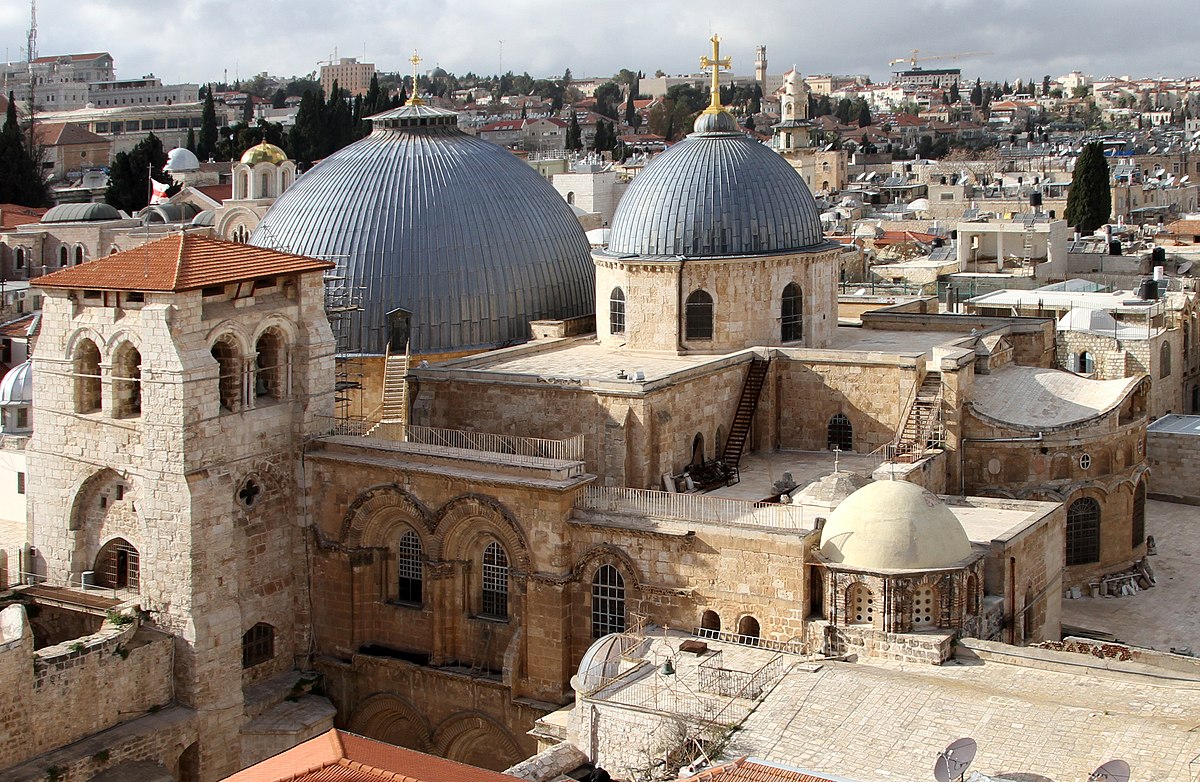
Wikimedia Commons

Berthold Werner (CC BY-SA 3.0)
Don't Miss
- Touch the Stone of Anointing where Jesus' body was prepared for burial
- Climb to Golgotha (Calvary) and see the rock of crucifixion under glass
- Enter the Aedicule — the shrine built over the empty tomb of Jesus
- See the ancient graffiti of Crusader-era crosses carved into the walls
- Visit the Chapel of St. Helena in the underground crypt
Inside the Church
The church is a complex, sometimes overwhelming space where multiple chapels, shrines, and sanctuaries overlap. Just inside the entrance, the Stone of Anointing (a reddish slab of stone) marks where Jesus' body was anointed before burial. To the right, steep stairs lead up to Golgotha, split between a Greek Orthodox and a Roman Catholic chapel. At the center of the rotunda stands the Aedicule, a small structure enclosing the tomb. Pilgrims often queue for hours to enter the tiny burial chamber inside. Below the main level, the Chapel of St. Helena (reached by Armenian-controlled stairs) contains a cistern where Helena is said to have found the True Cross.
The Status Quo
Six Christian denominations — Greek Orthodox, Roman Catholic (Franciscan), Armenian Apostolic, Coptic, Ethiopian, and Syriac Orthodox — share the church under a centuries-old agreement known as the Status Quo. Every chapel, stairway, lamp, and stone is assigned to a specific denomination, and even minor changes (like moving a chair) can cause disputes. A Muslim family, the Nusseibeh clan, has held the key to the church since the 12th century — a neutral arrangement to prevent conflict among the denominations. A wooden ladder on the facade, placed there before 1757, has remained untouched because no denomination has the authority to move it.
Visitor Information
Hours
Summer: 5:00-21:00, Winter: 4:00-19:00
Admission
Free
Duration
1-2 hours
Best Time to Visit
Early morning (5:00-7:00 AM) to avoid crowds and experience the quiet atmosphere.
How to Get There
- Walk through the Christian Quarter from Jaffa Gate
- Follow the Via Dolorosa from Lions' Gate
- Enter from the Muristan area
Tips
- Arrive very early to avoid long queues for the Aedicule
- Dress modestly — shoulders and knees must be covered
- Photography allowed but be respectful during services
- Free to enter — no tickets needed
Jerusalem Wall Art
Works Inspired by Jerusalem


More Things to Do in Jerusalem
The Western Wall (Kotel)
1-2 hours (add 75 minutes for the Tunnels tour) · Free (Western Wall Tunnels tour: ~35 NIS, advance booking required)
Walk the Old City's Four Quarters
Half day to full day · Free to walk (individual sites may have fees)
Temple Mount & Dome of the Rock
1-2 hours · Free
Mount of Olives
2-3 hours for the full walk from top to bottom · Free (some churches may have small entrance fees)
Yad Vashem Holocaust Memorial
3-4 hours minimum · Free
City of David Archaeological Park
2-3 hours · ~29 NIS adult (various combo tickets available)
Mahane Yehuda Market
1-2 hours · Free to enter (bring cash for purchases)
Israel Museum & Shrine of the Book
3-4 hours · ~54 NIS adult
Tower of David Museum
1-2 hours (museum), 45 minutes (night show) · ~40 NIS adult (museum), ~55 NIS (night show, separate ticket)